Index section ·one family plate
Astronomy
Named skies, instruments, and the objects that keep the index looking outward.
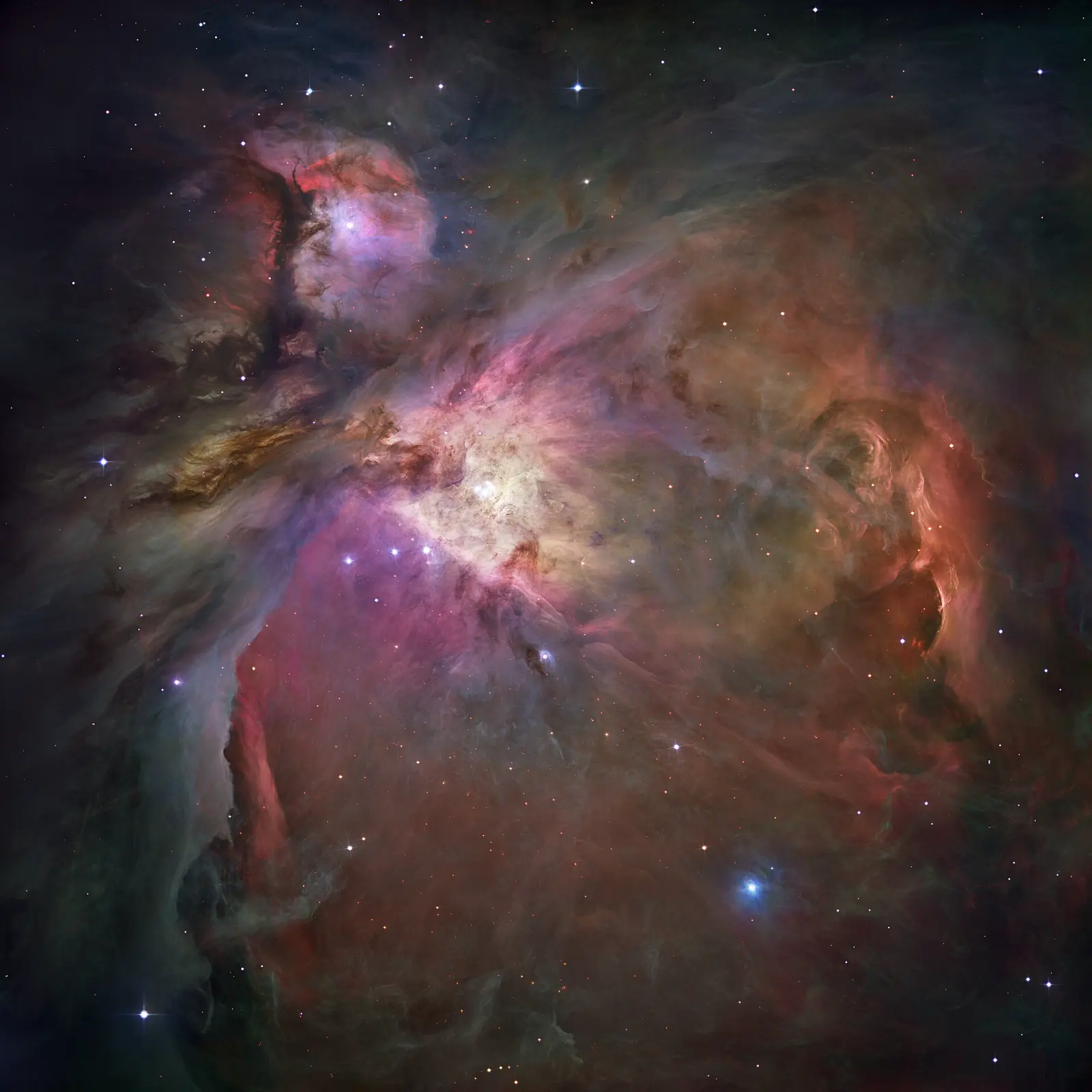
PhotoNASA, ESA, M. Robberto and the Hubble Orion Treasury Project TeamPublic domain

One plate, many entries
- 0°00′4/20 Sun · 0° Taurus
Every year the Sun walks into Taurus. Tropical longitude 30°00′00″. In this century that doorway is 19 or 20 April. 20 April 2023 it opened at 08:14 UT. Taurus is Venus’s earth sign. The calendar 4/20 is that threshold. Christmas is the other solar watermark: 4°20′ Capricorn, late December. Ingress here. Interior degree there. Two appointments. Not one law.
- 42 Aqr42 Aquarii
An orange giant, magnitude 5.34, about 447 light-years. Sadalsuud is β Aquarii, not this star. The 42 is Flamsteed’s number in the Water-bearer.
- 42 Aql42 Aquilae
A white subgiant, magnitude 5.45, about 105 light-years. High proper motion. The 42 is Flamsteed’s number in the Eagle.
- 42 Cas42 Cassiopeiae
A blue-white point, magnitude 5.17, about 293 light-years. Circumpolar from the north. The 42 is Flamsteed’s number in the Queen.
- 30 Dor42 Doradus
The giant H II region in the LMC is 30 Doradus / NGC 2070. Bode’s number in Dorado is 30. There is no 42 Doradus to index.
- 42 Dra42 Draconis
A K giant in Draco. Flamsteed numbered it 42. In 2015 the IAU named the star Fafnir. The star is real and keeps its seats. The planet once named beside it is another room.
- 42 LMi42 Leonis Minoris
A white binary, magnitude 5.35, about 412 light-years. The 42 is Flamsteed’s number in the Lesser Lion.
- 42 Lib42 Librae
An orange giant, magnitude 4.97, about 370–400 light-years. Visible as a faint naked-eye point. The 42 is Flamsteed’s number in the Balance, not a measured forty-two.
- 42 Ori42 Orionis
Orion’s Sword holds two 42s of different kinds. Flamsteed 42 Orionis is a hot B star. Messier 42 is a catalogue nebula. They sit in the same naked-eye stretch. 42 Ori ionizes NGC 1977, the Running Man, just north of M42. NASA: its radiation makes a young stellar jet visible.
- 42 Per42 Persei
A white A3V primary with a faint red-dwarf companion. Magnitude 5.11. About 300 light-years. Period 1.77 days. The 42 is Flamsteed’s number in Perseus.
- 4°20′ · 14°20′6 July 2027 · Venus 4°20′ · Sun 14°20′
The heart and the light in Cancer, five minutes apart. Venus prints 4°20′ at 14:56 UT. The Sun prints 14°20′ at 14:51 UT. Austin, 9:51 and 9:56 in the morning. 14°20′ is ten degrees on from 4°20′. Two marks. One sign. The 1988 weekend was Venus at 4°20′ Aries beside a civilizational ingress. This is Venus at 4°20′ Cancer beside the Sun at 14°20′. Age and heart was that rhyme. This one is heart and daystar. They are not one law.
- A42Abell 42
Material expelled at the end of a star’s life. M42 is birth. Abell 42 is the other end. Two catalogues. The parallel is editorial.
- mag 4.20Aculeus
M6, the Butterfly, is catalogued near magnitude 4.2. How we see. A cluster, not a star. NASA SkyView DSS of NGC 6405. Door to Scheat.
- 42Allen Telescope Array
The array that listens has forty-two dishes. Funding allowed 42 of a planned 350. SETI did not pick the integer as a joke.
- noneAndromeda null
The Book looked for a 42° Andromeda and did not find one. The miss is the object.
- (42) IsisAsteroid 42 Isis
The forty-second numbered asteroid, discovered 1856, named Isis. The number is a queue, not a hymn.
- C42Caldwell 42
About 135,000 light-years out. A halo relic. NASA: globulars like C42 are relics of the Galaxy’s youth. Unusually elongated orbit. May have been born elsewhere and later accreted.
- −52°42′Canopus
J2000 declination of Canopus is about −52°41′44″. Minus fifty-two degrees forty-two minutes is the rounded helm.
- 42.80 lyCapella
Hipparcos put Capella near 42.8 light-years. Gaia sits nearer 43.4. The Book printed 42.80. The later catalogue is not a miss of the earlier one.
- 42nd · 42 ComComa Berenices · 42
Two independent 42s in one hair. The constellation is 42nd of 88 by standardized area, 386 square degrees. Its Alpha star is 42 Comae Berenices. A 2015 eclipse prediction failed because three of 609 position angles were 180° wrong.
- 42 starsCygnus OB2 · 42
A spectroscopic survey took 61 candidates. 42 classified as new massive stars earlier than B3, including 11 O stars. The 42 is the confirmed sample, not a permanent census of Cygnus OB2.
- 4°20′ · 0°00′February 1988 · 4°20′ then two 0°s
A weekend of thresholds. Venus printed 4°20′ Aries at 04:53 UT on 13 February 1988, 22:53 the 12th in Texas. Saturn entered Capricorn at 23:51 UT that same 13th. Uranus entered Capricorn at 00:11 UT on the 15th, 18:11 the 14th in Texas. The American civil days on the plate are the 12th, 13th, and 14th. The tables print in UT. Saturn and Uranus had conjoined at 29° Sagittarius on the 13th, then both walked into Capricorn. Venus is a fast neighbor on those days. Not the conjunction.
- 42 starsFission · 42 stars
Forty-two old stars keep a chemical fingerprint of atoms heavier than uranium breaking apart, before those stars were born. A laboratory cannot run that experiment. The 42 is how many stars were in the study.
- ~42 M⊙GW231029
The lighter black hole sits near 42 solar masses. Recovered 29 October 2023, 11:15:08 UTC, it is a number in the strain, not a stamp on the sky.
- 42 inHall Telescope
A research workhorse since 1970. Asteroids, comets, solar analogs. The 42 is the aperture in inches.
- 42 elementsHD 222925
One old star, far in Tucana. Hubble counted its metals. Forty-two of them, from gallium toward thorium, including gold. The most complete such inventory then known beyond the Sun.
- 42 PegHomam
The luck of the hero. A B star, magnitude 3.41, about 204 light-years. Bayer ζ Peg. Flamsteed 42. The 42 is the catalogue seat, not a measured forty-two.
- 28°42′Jupiter–Uranus 28°42′
A misname, not a missing rock. The Book already prints Jupiter–Uranus that day. Search 28°42′ on Stars.
- 42 CCDsKepler · 42 CCDs
NASA’s Kepler telescope watched stars with a camera of forty-two chips. A planet walking in front of its star makes a tiny blink. Those chips, ninety-five million pixels, were how worlds too small to photograph were still found. Later, catalogue number 42 was a red dwarf with three close planets. The camera’s 42 and the star’s 42 are two different lists.
- Kepler-42Kepler-42
A small red star, about a sixth the Sun, 131 light-years away. Three planets, all smaller than Earth, all closer than Jupiter’s moons, all finishing a lap in under two days. NASA drew the family twice so the scale can be felt.
- Kepler-420Kepler-420 b
A sequential 420 in the Kepler catalogue. Scientifically interesting orbit. Numerically weaker than Kepler-42 because 420 is a large running number.
- 42Meet the 42
In 2021 ESO imaged forty-two of the largest rocks between Mars and Jupiter. Psyche was one of them. The release is titled Meet the 42.
- ~4.2Merope
Merope’s mean V magnitude is +4.18. Some catalogues round her to 4.2. Hubble caught the cloud she is tearing, IC 349. Family is 4.2, not 42. Glare is a looking-lesson.
- M42Messier 42
The Orion Nebula is object 42 in Messier’s catalogue · a name, not a measurement of forty-two.
- 4°21′New Moon · Aquarius 4°21′
The year she turned forty-two opened with a New Moon at Aquarius 4°21′, 24 January 2020, 21:41 UT. Astro-Seek prints 4°21′. The plate’s 4°20′/4°21′ and 21:42 UTC are the same lunation, one minute and one arcminute of rounding.
- 42 membersNGC 1333 · 42
A census of a young cluster. 42 new members, some into the brown-dwarf regime. The 42 is the confirmed sample.
- 42 starsNGC 2264 · 42
Flux at 1.6, 2.2 and 3.4 μm for 42 stars. Many show infrared excess from circumstellar dust. The 42 is the sample they measured.
- 42 Dra bOrbitar
In 2009 a wobble around 42 Draconis looked like a giant planet. In 2015 the IAU named it Orbitar. Later radial velocities did not follow that orbit. Infrared light from the star pulsed on the same period. There is no giant planet. The name is empty.
- ~42°Polaris at 42°
The north celestial pole’s altitude is the observer’s latitude. Polaris is currently ~0.5° off the pole. At 42° N you see it near 42°.
- 4.24 lyProxima b
Nearest other fire. 4.24 light-years. Announced 24 August 2016. Family 4.2, not 42. The Stars field keeps it beside Capella and Toliman as a neighbor, not as a hit.
- RCW 42RCW 42
About 5.8 kpc. Luminosity around 1.8×10⁶ L☉. Young stellar objects, molecular clumps, ALMA cores. The 42 is Rodgers–Campbell–Whiteoak.
- 24°42′Seam 24°42′
Twenty-four degrees forty-two minutes is a printed seam, not a second rainbow. 24 | 42 remain distinct marks.
- 4°20′Sidereal Mars · Cancer 4°20′
He posted at 20:39 UTC. The Austin clock is 15:39. On that sidereal chart Mars prints Cancer 4°20′. Lahiri ayanamsa 24°08′. Whole sign. Rising Cancer. Mars in the first house at the 4°20′ mark. Tropical Mars is not this print. The tweet and the sidereal degree share a minute.
- 4°20′Sun at Christmas · 4°20′ Capricorn
Every December the Sun returns to 4°20′ Capricorn. Feast day and solar longitude share a calendar. No one had to plan the overlap.
- 18°42′Super Moon · Libra 18°42′
A Super Moon at Libra 18°42′, 8 April 2020, 02:34 UT. The American civil day is 7 April.
- 42°Thuban
Thuban was the pole in the pyramid age. The present north, at 42°, is Polaris. Two stars. One latitude tautology.
- 4h20mTowel Day
On the first Towel Day, Saturn crossed 4°20′ Gemini at 07:33 UT, the Moon 4°20′ Cancer at 10:03, the Sun 4°20′ Gemini at 11:53. First to last is 4 hours 20 minutes. Fans picked the date as a wake, two weeks after Adams died. Their FAQ said it had no special meaning. The clocks were read later.
- 13°42′Venus cazimi · Gemini 13°42′
3 June 2020. Venus, retrograde, prints Gemini 13°42′ at 13:41 UT. The Sun meets her there. Cazimi. NASA’s APOD that day is the inferior conjunction, Venus and Earth at their closest. Two clocks. One date. 42′ on the ecliptic print.
- 4.2 mWilliam Herschel Telescope
Western Europe’s largest for years. Altazimuth. 4.2-metre primary. The decimal is the aperture.
- 0°00′xAI day · Node 0° Taurus
On 12 July 2023 the Node prints 0°00′00″ Taurus at 16:52 UT, retrograde. That is the same civil day as the xAI announcement. The 42 is the date-sum he wrote. The sky that day is a zero, not a forty-two. Two prints. One date.
- 42.42 minXTE J1751−305
A tiny spinning star and a lighter companion race around each other. RXTE timed the dance at 2545.3 seconds. The discoverers wrote that as 42 minutes. The seconds are 42.42 minutes, not 42.00. A clock in the sky, not a hole through the Earth.