Index section ·one family plate
Planetary
Worlds, moons, and the missions that measured them.
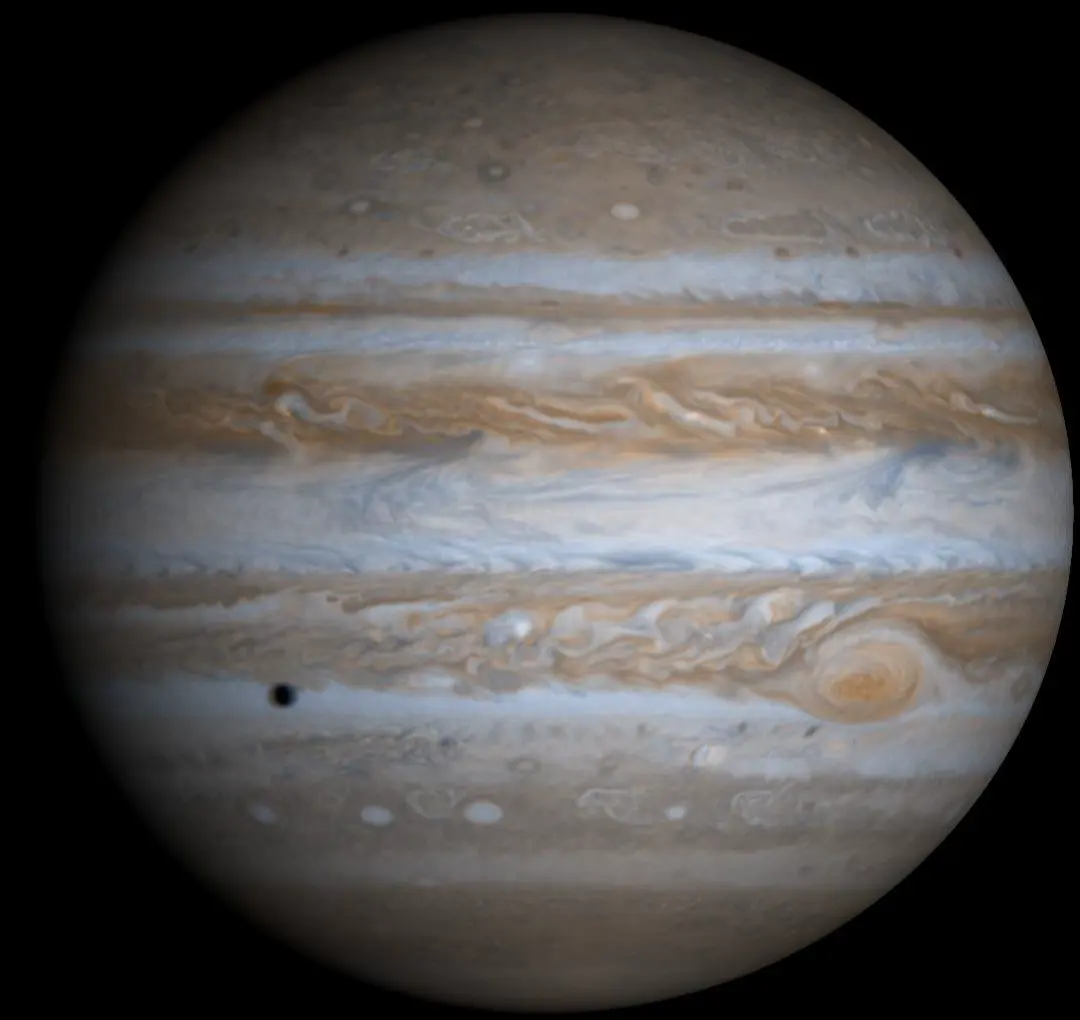
Photo ·Public domain

One plate, many entries
The banner is a family signal. Each entry keeps its own meaning and receives the same copper accent without repeating a full image.
- 142142 sols
FORTY TWO and ELON REEVE meet at 142, which is 42 wearing a 1.
- 16 Psyche16 Psyche
A metal-rich world NASA is flying toward. Density printed 4.20. Day about 4.2 hours. The site is psyche.grok.me. Himeros is a crater on a different rock.
- 4 Vesta4 Vesta
The second-largest asteroid. Dawn lived there. The spin pole sits near 42.23° north. Park 2025 prints a polar moment of inertia 0.4208. Four is the catalogue number. The 42s are the rooms.
- 433 Eros433 Eros
The love asteroid. NEAR mapped it. The IAU named its craters for lovers. Himeros is longing and reduces to 42. Psyche crater is the soul and does not. Hinks Dorsum prints 42.00° north. The site is eros.grok.me. Sixteen Psyche is another world.
- 42 daysApollo 12 S-IVB
The stage missed the Sun-centered path. NASA prints the orbit: 101,350 by 535,522 miles, period 42 days. A leftover engine with a numbered period. Later it was mistaken for an asteroid.
- 42 imagesCassini farewell · 42 images
Two days before the plunge, Cassini’s wide-angle camera took a last full portrait. The natural-color mosaic is 42 of 80 frames, red, green, and blue. Image scale on Saturn is about 42 miles per pixel. That scale is a neighbor, not this count.
- four namedHearth. Soul. Love. Longing.
Vesta is the hearth. Psyche is the soul. Eros is love. Himeros is longing. Four names. Four different rulers. A spin pole is not a density. A cipher is not a catalogue number. This card is the meeting, not a fifth 42.
- 42Himeros
On the love asteroid there is a crater named for longing. Himeros, attendant of Eros, personification of the longing of love. NEAR found it. The IAU kept the name. The English letters of HIMEROS reduce to 42. Psyche crater, the soul, sits on the same rock. Narcissus too. The 42.00° ridge is another room.
- 42.00°Hinks Dorsum
A ridge on Eros prints at 42 degrees north in the gazetteer. Named for Arthur Robert Hinks, who used this asteroid to measure the Sun’s distance. The longing crater is next door, and is not this pin.
- ~42.46 hIo’s orbit
Io completes one orbit in 1.769 days, about 42.46 hours. Forty-two is the rounding, not the clock. Laplace 4:2:1 with Europa and Ganymede is the physics.
- 42 orbitsJuno · 42 orbits
When NASA extended Juno in January 2021, the plan scheduled 42 more orbits. Close passes of Ganymede, Europa, and Io. Rings. Polar cyclones.
- ~42 kmKeeler Gap
The Keeler Gap in Saturn’s outer A ring is about 42 km wide. Tiny Daphnis orbits in the lane and raises waves on both edges.
- ≈42 AUKuiper collisions ≈42 AU
A model, not a rock that happened to sit at a nice distance. Beyond about 42 AU, dynamical instability times exceed the age of the system. Collisions take over. NASA NTRS holds the paper.
- ~42 kmMariner 10 · S-band 42 km
Mariner 10’s S-band signal reached about 42 km in Venus’s atmosphere before absorption extinguished it. The X-band died higher, near 50 km.
- 42 minMariner 2 · 42 minutes
On 14 December 1962 Mariner 2 flew 21,660 miles from Venus and scanned the planet for 42 minutes. First spacecraft to complete a planetary encounter.
- ~420 kmMars south polar cap
In Mars Global Surveyor’s 17 April 2000 summer image, the residual south polar cap is about 420 km across. Seasonal. Carbon dioxide frost in that view.
- 42 ≈ 79Mars years
Seventy-nine Earth sidereal years contain very nearly forty-two Mars years · about two days of drift over the whole span.
- MercuryMercury
The messenger planet. A thin silicate shell near 420 km. On 20 April 1971 the table prints speed −0°42′ per day. Tesla’s incorporation morning, Mercury at 4°20′ Cancer. Mariner 2 and Mariner 10 are Venus rooms. They do not live here.
- −0°42′/dMercury · −0°42′/d
The 19th is inferior conjunction. The 20th is minimum elongation. The speed is a table print. 20 Apr 1971: elongation 0°14′ W, Mercury 29°08′, retrograde, −0°42′ per day. Evening Rise is 28 Jun, sixty-nine days after the 20th.
- ~420 kmMercury · outer shell
Mercury’s metallic core leaves a thin silicate shell. MESSENGER gravity and spin put that outer shell near 420 km, with a 30 km uncertainty. NASA’s public facts page rounds the same structure to about 400 km.
- 4°22′Node · Mars 4°22′
The natal aspect list prints Node conjunct Mars at 4°22′. Two arcminutes past 4°20′. A near-hit is not a 42.
- 45.42 sPsyche 45.42 seconds
A 1982 paper measured Psyche’s sidereal day as 4 hours 11 minutes 45.42 seconds, plus or minus a hundredth. Four oppositions. The hundredths can move.
- PsychePsyche crater
On the love asteroid there is a crater named for the soul. Psyche, beloved of Eros. NEAR found it. The IAU kept the name. It is not a 42. Himeros, longing, sits on the same rock and is. Asteroid 16 Psyche is another world.
- 4.20 ± 0.60Psyche density
Our 3D shape along with existing mass estimates imply a density of 4.20 ± 0.60 g cm⁻³, so far the highest for a solar-system object after the four telluric planets. One 2020 print. Not the last word on the density.
- 0.42Psyche radar albedo
A 2008 radar paper printed Psyche’s mean radar albedo as 0.42, ranging from 0.26 to 0.51. The number is a published measurement. It is not Psyche’s eternal 42.
- ~4.2 hPsyche’s day
Psyche’s present day is about 4.2 hours. Ferrais 2020 reads the shape as a slowed Jacobi ellipsoid that once spun nearer three hours. Four-point-two is a rounding of a spacecraft-grade period, not 42.
- unmeasuredPsyche’s magnetic field
The asteroid does not generate a field the way Earth does. If it once had a core dynamo, that field may still be written in the metal. The spacecraft will look. Arrival 2029.
- ~420 kmSacajawea Patera
NASA’s Magellan caption prints Sacajawea’s scene as about 420 km wide at the base. The patera is a 120 by 215 km depression on Lakshmi Planum. Frame width is not caldera diameter.
- 24h 39m 35sThe sol
A sol is a Mars solar day. Almost a terrestrial day, which is the trap. Crews live on sol clocks. Thermal design does not live on almost.
- ~42 yrUranus half-cycle
Uranus orbits in ~84.02 years. Half is ~42. A pole sees ~42 years of sun, then ~42 of dark.
- 0.4208 ± 0.0047Vesta polar MOI
Dawn’s gravity, reprocessed for a decade, prints Vesta’s polar moment of inertia as 0.4208, plus or minus 0.0047. Close to a uniform rock. The core is small. This is the 2025 paper. The spin pole is another room.
- 42.23°Vesta spin pole
Vesta’s north pole sits a little past forty-two degrees. Dawn measured it. The IAU kept it. Three writings of one pin: 42.23, 42.235, 42.2319. Not 42.00. Hinks is the other ridge.