Public index · Planetary
Kuiper collisions ≈42 AU
≈42 AU
Stern 1995. Collisional evolution is likely the dominant process beyond approximately 42 AU in the Kuiper Disk.
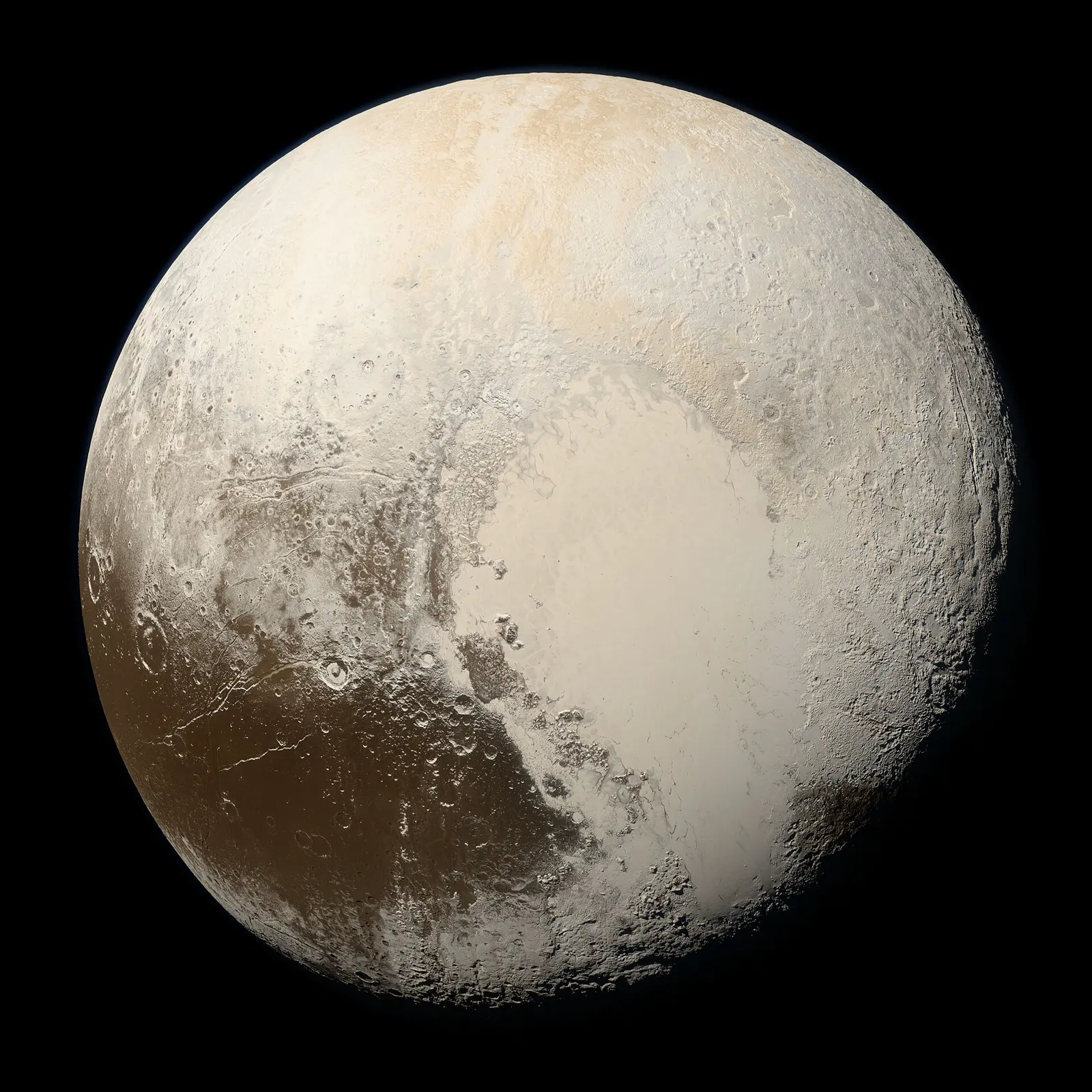

A model, not a rock that happened to sit at a nice distance. Beyond about 42 AU, dynamical instability times exceed the age of the system. Collisions take over. NASA NTRS holds the paper.
NASA / JPL
Printed 42s
A proton count. A catalogue seat. A scan. A model boundary. A patch that draws 4 and II. A joke a JPL scientist made in public. Different kinds. NASA printed them. That does not make them one Answer.
The metal
- Z = 42Molybdenum
Proton count. The integer was 42 before Adams.
- jokeDouglas Adams element
Russell at JPL named the metal. NASA printed the joke.
Sky and distance
- M42Orion Nebula
Catalogue seat. NASA’s Cosmic Hearth is Maya reception.
- C42Caldwell 42
Another catalogue. NGC 7006. Not a measured forty-two.
≈42 AUKuiper collisionshere
Stern 1995. A modeled boundary, not Albion’s distance.
- 42.1 km/sSolar escape
Vis-viva at 1 AU. Family 4.2, not 42.00.
Missions and tools
- 42 minMariner 2
A scan of Venus. Duration, not a law of the planet.
- 42 dApollo 12 S-IVB
Missed heliocentric burn. NASA prints the period.
- 42Expedition 42
Sequential crew number. The patch draws 4 and II.
- STS-42STS-42
Shuttle number. Discovery, IML-1.
- 42Horizons keywords
JPL’s own manual. A documentation count.
What it supports
S. Alan Stern, Astronomical Journal 110, 856 (1995). Abstract: collisional evolution is likely the dominant evolutionary process beyond ≈42 AU. NTRS 19970010613. A modeled boundary in a NASA-held paper.
What it does not
Not the first KBO’s distance. NASA’s 1992 QB1 pages print about 44 AU, not 42. Albion is a different object. Not a New Horizons flyby milestone.
Calculation
Beyond ≈42 AU, dynamical instability timescales exceed the age of the solar system.
Collision-rate model of the present-day Kuiper Disk. Stern, AJ 110, 1995.
ExactnessRange / bound
Form42
UnitAU
Strengthhard
Hung16 September 2026