Public index · Mathematics
Pronic · 6×7 and 20×21
6×7 · 20×21
42 = 6×7. 420 = 20×21. Both are pronic: n(n+1). Also the sums of the first six and first twenty even integers.
A pronic number is two consecutive integers multiplied. Six times seven is 42. Twenty times twenty-one is 420. They sit in the same sequence. Not 42 × 10 in a trenchcoat. The same theorem says 42 is the sum of the first six even numbers, and 420 the sum of the first twenty. The generating rule was there before anyone wanted a 42.
Sequence · n(n+1)
6 × 7 = 4220 × 21 = 420
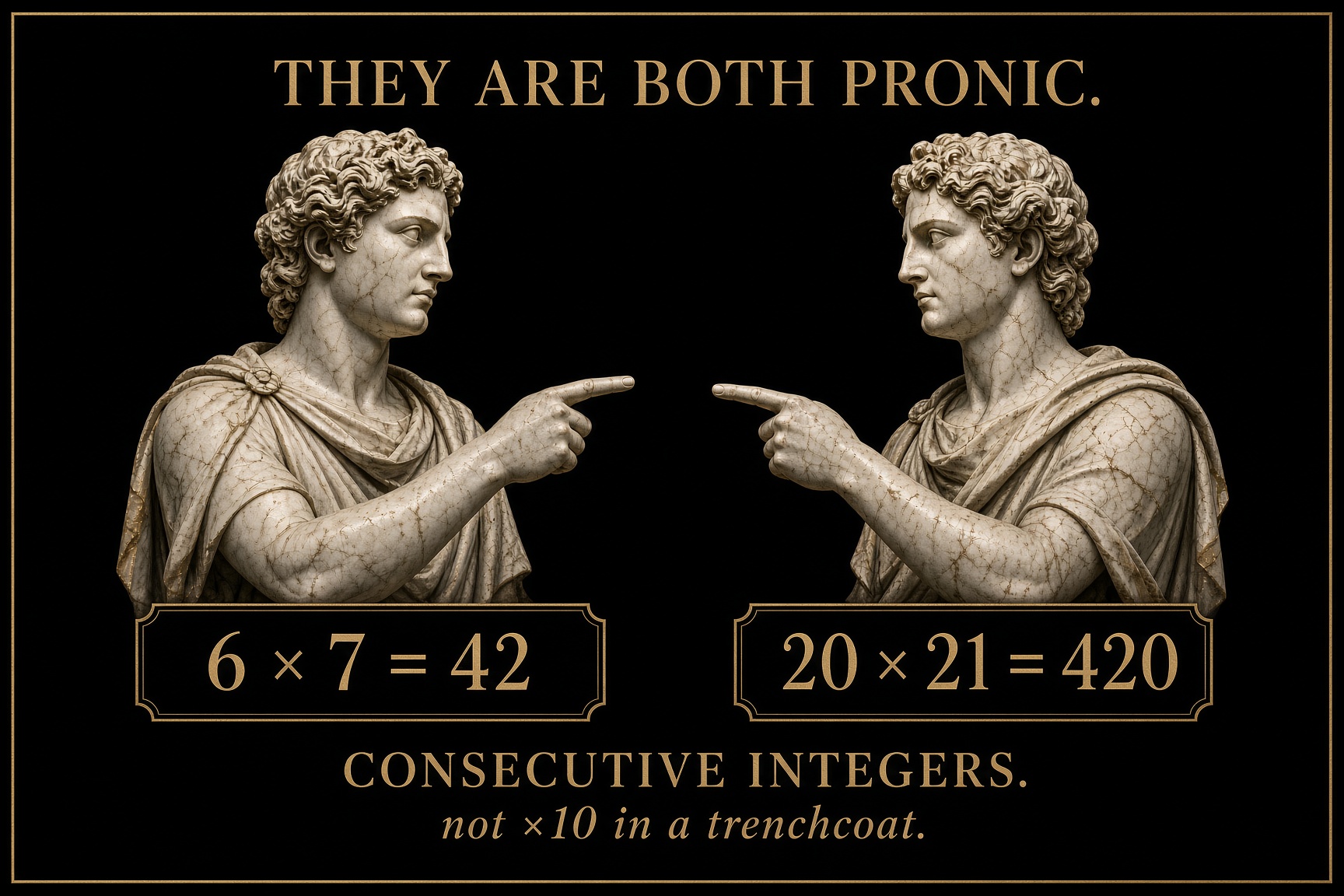
A pronic number is two neighbors multiplied. Forty-two is six times seven. Four hundred twenty is twenty times twenty-one. The same theorem says 42 is the first six even numbers added, and 420 the first twenty. The sequence was named before anyone asked for a 42.
What it supports
OEIS A002378. n(n+1) = 2+4+…+2n. Distinct from LCM(1…7)=420, which is another exact office of the same integer.
What it does not
Not decimal scaling as the reason. Not the Moon ratio. Not 69ⁿ mod 420.
Calculation
6×7=42. 20×21=420. 2+4+6+8+10+12=42. 2+4+…+40=420.
Pronic n(n+1). Independent sequence membership, not a search for 42.
ExactnessExact
Form420
Unitinteger
Strengthhard
Hung9 September 2026